Penguin Solitaire — Play Free Online
Penguin Solitaire is an elegant open-information solitaire card game invented by David Parlett. Unlike most solitaire games, every card is dealt face-up from the start — you have perfect information and the puzzle is purely strategic. With a win rate of approximately 90%, Penguin is both approachable and deeply satisfying.
- Move all 52 cards onto the four foundation piles, built in suit from the Beak rank through a full cycle.
- The Beak (first card dealt) sets the starting rank for all four foundations — build from there.
- Stack tableau cards in descending order within the same suit only — wraparound applies (A follows K).
- Park any single card in the Flipper row as temporary storage — 7 cells total, use them wisely.
- Only a card of rank one below the Beak can start a new empty tableau column.
- Made a mistake? Hit Undo to take back your last move.
- Stuck? Press Hint and the game will highlight a valid move for you.
How to Play Penguin Solitaire
The goal is to move all 52 cards onto the four foundation piles, each built in suit from the "Beak" rank through a full wraparound cycle.
Game Setup
- Beak: The first card dealt becomes the Beak — its rank is the starting rank for all foundations. The Beak is placed at the bottom of the first tableau column.
- Foundations: The other three cards matching the Beak's rank are placed directly onto the four foundation piles (one per suit). The foundation for the Beak's own suit starts empty; the Beak will eventually be the last card moved there.
- Tableau: Seven columns of seven cards each are dealt face-up. Every card is visible from the start.
- Flipper: Seven empty reserve cells beneath the foundations. Each cell holds one card at a time.
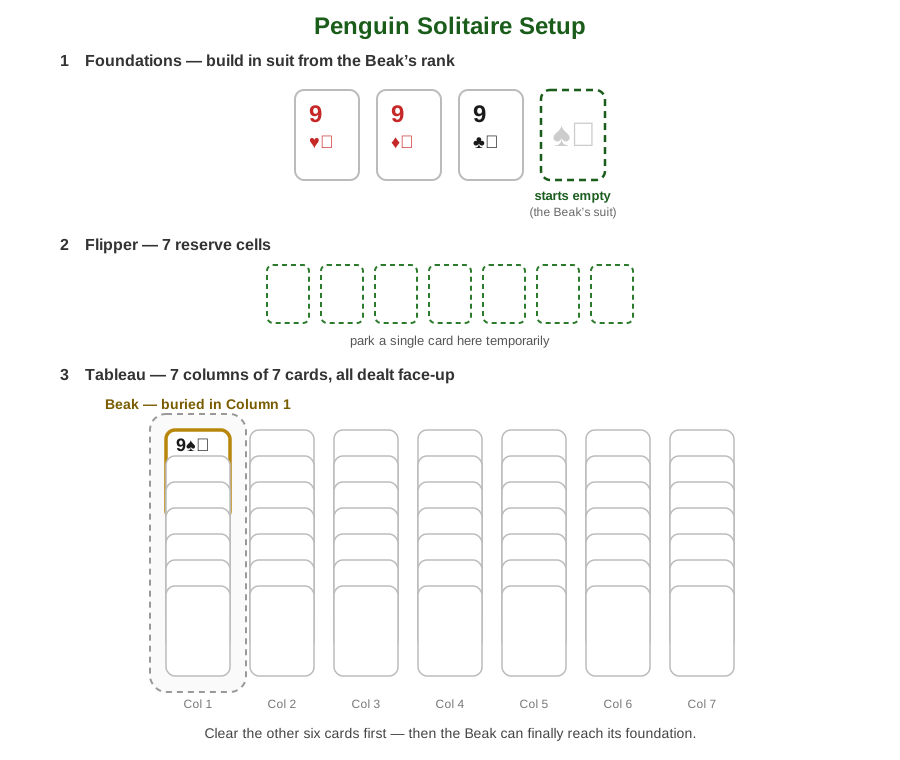
Building the Foundations
Each foundation builds up in suit with wraparound: after King comes Ace, then 2, 3, and so on. For example, if the Beak is a 9, foundations build: 9 → 10 → J → Q → K → A → 2 → 3 → 4 → 5 → 6 → 7 → 8.
Building the Tableau
Cards in the tableau stack in descending order within the same suit. For example, the 8 of hearts can go on the 9 of hearts. The rank wraps around — an Ace goes on a 2, and a King goes on an Ace.
Empty tableau columns may only be filled by a card of rank one below the Beak (e.g. if Beak=9, only an 8 can start an empty column).
Moving Sequences
You can move an entire same-suit descending run as a unit — drag the top card of the sequence and the rest follow.
Using the Flipper
Drag any single card to an empty Flipper cell to park it temporarily. Drag it back out to the tableau or foundation when ready. The Flipper is strategic — use it wisely, as all seven cells can fill up.
Penguin Solitaire Tips and Strategy
- Plan your Beak move: The Beak is buried at the bottom of column 1. Plan tableau moves to free that column so the Beak can finally reach its foundation.
- Don't fill the Flipper carelessly: With only 7 Flipper cells, parking the wrong cards can lock you out of key moves. Prioritize cards that will move to foundation soon.
- Build foundation evenly: Try to keep all four foundation piles at similar levels to maximize flexibility.
- Think in suits: Every tableau sequence must be the same suit, so mentally group cards by suit when planning.
- Empty columns are powerful: An empty tableau column lets you reorganize runs — but remember, only a specific rank can start a new column.
Features of Our Free Online Penguin Solitaire
- No download required: Play instantly in your browser on desktop or mobile.
- Unlimited free games: Every shuffle produces a new puzzle to solve.
- Hint system: Stuck? Click Hint for a suggested move.
- Undo moves: Take back any move to try a different strategy.
- Statistics tracking: Track your wins and streaks across sessions.
- Mobile friendly: Full touch and drag support for phones and tablets.
Frequently Asked Questions
What is Penguin Solitaire?
Penguin Solitaire is an open-information solitaire game invented by David Parlett. All 52 cards are dealt face-up across seven columns, giving you perfect information about every card's location. The goal is to build all four foundation piles in suit from the "Beak" rank through the full cycle.
What is the Beak?
The Beak is the first card dealt — it becomes the starting rank for all four foundation piles. The other three cards of the same rank are immediately placed on the foundations. The Beak itself is buried at the bottom of the first tableau column.
What is the Flipper?
The Flipper is a row of seven reserve cells, each holding a single card. You can drag any single card to an empty Flipper cell to store it temporarily, then drag it back to the tableau or foundation later.
How does rank wraparound work?
After King comes Ace in the foundation sequence, then 2, 3, and so on. Similarly in the tableau, an Ace packs onto a 2 (one rank lower in the cycle), and a King packs onto an Ace.