

Solitaire is one of the most-played card games ever made. You can play free right now in your browser (no setup, no download) or grab a physical deck and follow along. This guide covers both.
What is solitaire?
When people say "solitaire," they almost always mean Klondike, the version that shipped with Windows in 1990. That one decision put it on hundreds of millions of computers and it's been the default ever since.
The goal is to move all 52 cards to four foundation piles, sorted by suit from Ace to King. Getting there requires patience, some planning, and a fair amount of luck.
What you need
A standard 52-card deck. No jokers. That's it.
If you're playing online, everything is set up for you already.
How to set up the cards
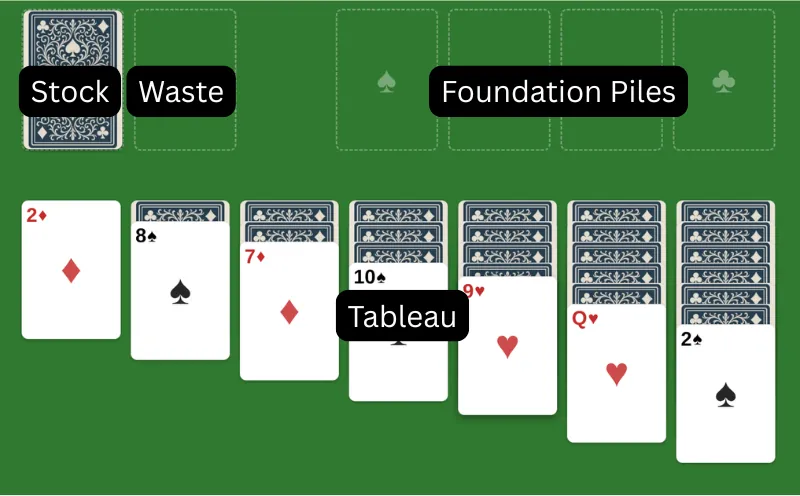
The layout looks complicated the first time. It has named sections, and once you know what they're called the rules start making sense.
Step 1: Deal the tableau
The tableau is the main playing area. It has seven columns spread across the table. Deal them like this:
- Column 1: 1 card face-up
- Column 2: 1 face-down, then 1 face-up on top
- Column 3: 2 face-down, then 1 face-up on top
- Column 4: 3 face-down, then 1 face-up on top
- Column 5: 4 face-down, then 1 face-up on top
- Column 6: 5 face-down, then 1 face-up on top
- Column 7: 6 face-down, then 1 face-up on top
That uses 28 cards. Each column has one face-up card showing on top; everything below it is hidden.
Step 2: Set aside the stock pile
The remaining 24 cards go face-down in the upper-left corner. This is the stock pile. You draw from it when you run out of moves in the tableau.
Step 3: Leave room for the foundations
In the upper-right, leave four empty spaces, one per suit. These start empty. You'll build them up during the game, beginning with Aces.
When you're done it should look like this: stock pile in the upper-left, four empty spaces in the upper-right, seven columns of cards in the middle.
The four areas
The tableau is where most of the game happens. These are the seven columns where you move cards around to expose the hidden ones.
The stock pile is where you draw from when you're stuck. You flip one card at a time into the waste pile.
The waste pile holds the most recently drawn card. The top card there is always available to play.
The foundations are the goal: one pile per suit, built from Ace up to King. Once a card goes on a foundation, it stays there.
The rules
Moving cards on the tableau
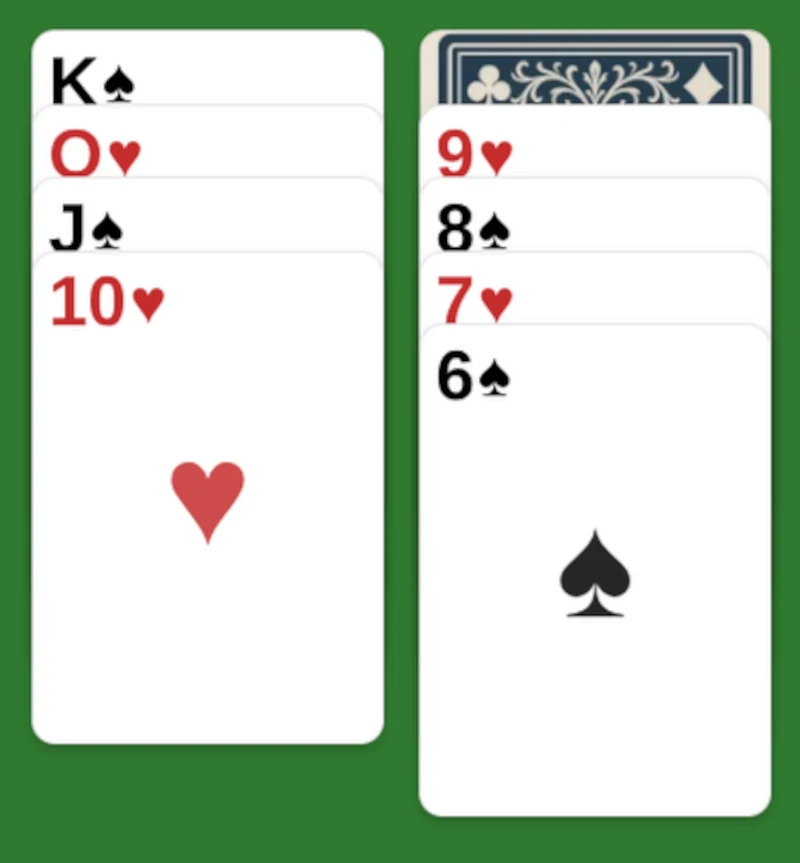
Two rules govern every move on the tableau:
- Cards go in descending order: a 7 can only go on an 8
- Cards must alternate colours: red on black, black on red
So a black 6 goes on a red 7, and a red 10 goes on a black Jack.
Moving sequences
Face-up cards already in a valid sequence can move together as a unit. If you have a red 6 sitting on a black 7, you can pick both up and drop them onto a black 8.
Moving to the foundations
A card goes to a foundation when it's an Ace (starting that suit's pile) or the next card up in sequence for that suit. So 3♠ goes on 2♠, and so on.
Empty columns
Clear a column entirely and only a King can fill it, or a sequence that starts with a King. These spaces are worth something. Don't fill them casually.
Recycling the stock
When the stock runs out, flip the waste pile back over to form a new one and keep going. You can do this as many times as you need.
How a game plays out
Before any move, scan the whole tableau. Look at what's face-up and figure out what's actually available.
Move any Aces straight to the foundations. There's no reason to leave one sitting in the tableau.
After that, focus on uncovering hidden cards. Every face-down card you flip over opens new options. When two moves are both valid and one reveals a hidden card while the other doesn't, take the one that flips.
Draw from the stock when you're stuck, but look at each card when you flip it. Can it go anywhere? Does it open something up? Cycling through the stock without thinking is how you waste a card you actually needed.
Then just keep going: flip, move, repeat, until everything is on the foundations or you're out of moves.
Mistakes most beginners make
Clearing a column with no King ready. An empty column is useful, but only if you have something to put in it. Free one up with nothing to fill it and you've wasted a move.
Moving cards to the foundations too fast. It feels like progress. It isn't always. Move a black 2 to the foundation and then draw a red 3 from the stock. Now you've blocked yourself. A useful rule: try to keep all four foundation piles within a rank or two of each other. One suit racing to 8 while another sits on 3 is a problem.
Forgetting the waste pile. The top card there is always available. After every draw, check it. Beginners miss free moves here all the time.
A few things that actually help
Uncovering hidden cards should be your first priority. More of the tableau visible means more moves available.
Use undo freely. Sometimes the only way to know if a move was worth it is to try it and see what it reveals.
Be careful about which King you drop into an empty column. A King with a long useful sequence already attached to it is worth a lot. A lone King sitting in an empty column is usually just dead space.
Can you always win?
No. Roughly 79–82% of Klondike deals are theoretically winnable with perfect play, so about one in five simply can't be beaten no matter what you do. If you're stuck and genuinely can't see any path forward, it might just be one of those games.
Give it a go
The online version handles all the setup. Start a free game here. There's a hint button if you need it, and undo works on every move.