
Four-suit Spider is a different game from the one-suit version. In one-suit Spider, almost any card you place extends a same-suit run, because there's only one suit to work with. In four-suit, three out of every four cards you place will break one. That single fact is the whole difficulty curve. Open 4-Suit Spider and keep these in mind.
Set your expectations first
There's no official win-rate study for 4-suit Spider the way there is for Klondike. Treat any number you see here as an estimate, not a settled fact. The figures that come up most consistently across solitaire sites and solver experiments put skilled play at somewhere around 5-15% of deals won, with average players well below that. Some sources put the theoretical ceiling (every deal solved with perfect information and unlimited backtracking) as high as a third of games. Perfect information is exactly what you don't have at the table, though.
The point isn't the exact number. It's that losing most 4-suit games is normal, not a sign you're doing something wrong. The strategy below is about shifting your odds, not guaranteeing a win.
Build in suit whenever you have a choice
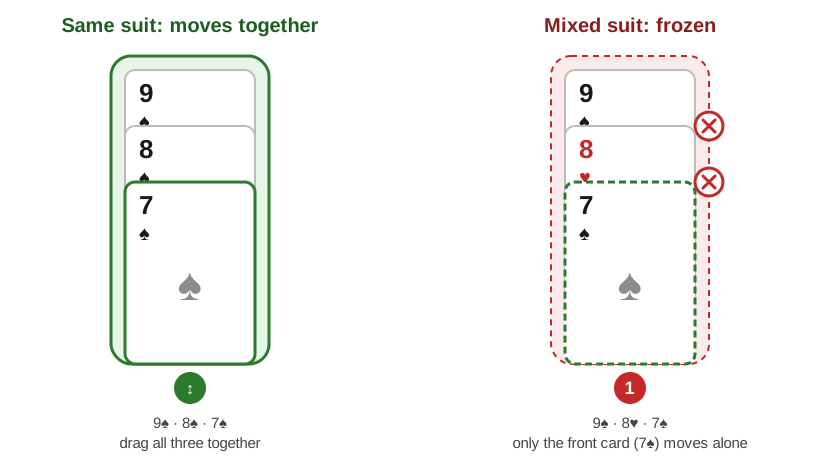
Any card can land on a card one rank higher, regardless of suit. That part of the rule is the same across every Spider variant. What changes is what you can pick up afterward. In this game, a group of cards only moves together if it's a same-suit descending run. A 9♠-8♥-7♠ stack is three legal placements, but it's frozen: you can't relocate the 8 or 7 without breaking it apart card by card.
So whenever a card could go on more than one legal spot, prefer the one that keeps the run same-suit. A same-suit run is a single movable unit later; a mixed run is a pile you'll have to dismantle one card at a time when you need what's underneath it.
Treat the stock as a last resort
Dealing from the stock puts one card on every column at once, face-up, whether or not that column was in good shape. If four of your columns had clean same-suit runs building nicely, the new cards land on top of all four and break them.
Exhaust your tableau moves first. Only deal when nothing else is available, or when you genuinely need the stock cards to unstick a column that has no other way forward. Deal too early out of impatience and you're not adding options. You're burying the ones you already had.
Go after one empty column, not several
An empty tableau column is the only real "free space" in Spider. There are no free cells and no reserve to fall back on. It's where you stage cards while you sort a tangled column into the right suit order.
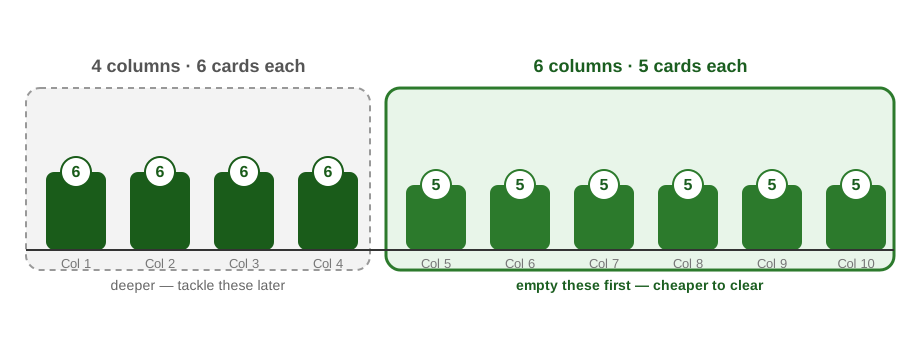
Not all columns are equal at the start. In this layout, four columns are dealt six cards and six are dealt five, and the five-card columns are cheaper to empty. Pick one of those and focus your early moves on draining it, rather than spreading effort evenly across the board. One clear column early is worth more than partial progress on three.
Once you have it, don't fill it automatically just because a card fits. An empty column is a resource. Spend it on a move that actually gets you closer to a same-suit run, not on the first legal placement that comes along.
Uncovering a card beats almost everything else
Every column has face-down cards buried under the face-up ones you started with. Until a card is flipped it's neither information nor a move. It's just a wall. Getting it face-up is very often better than a move that looks more productive on the surface, because you don't know what you're unlocking until you see it.
Given a choice between two legal moves, and one flips a new card while the other just rearranges face-up cards, take the flip. It's also exactly what the hint button in this game favors: if you're stuck, it looks for the reveal first and same-suit building second.
If you have to build off-suit, use high cards for it
Sometimes there's no same-suit option and you have to drop a card on a different suit just to keep moving. When that happens, do it with the highest-ranked card you can, not the lowest.
A queen sitting on a king from a different suit still has ten more cards' worth of room to extend downward before it runs into an ace and dead-ends. A 3 in the same spot gives you almost nothing: one or two placements and the column is stuck until you clear it. Off-suit builds are a cost either way; a high card just costs less.
Use undo to scout, not just to fix mistakes
A move you can't undo is a move you have to get right the first time, every time, and that's a lot to ask in a position where you can't see the face-down cards. Play the move you think is right, look at what it actually does to the column underneath, and step back if it's worse than it looked. That includes stock deals: if dealing ten new cards turns out to bury more than it helps, undo covers that too.
That's not cheating. It's using information you genuinely didn't have until after you'd already made the move. The skill is in reading the position afterward, not in never touching undo.
When you complete a suit, regroup immediately
Finishing a full king-to-ace run clears it off the board entirely and usually flips a new card underneath. That's real progress, but it also resets the shape of your columns. Don't coast on the momentum. Look at what the board actually looks like now, and figure out which suit you're building toward next before your next move turns into autopilot.
The short version
Build same-suit whenever it's an option. Save the stock for when you're actually stuck. Empty one column before you worry about a second. Flips beat almost every other consideration. If you must go off-suit, do it high. Undo when a move teaches you something you didn't know before you made it.
None of this makes 4-suit Spider easy. It isn't supposed to be. One-suit Spider and two-suit Spider are the easier on-ramps if you want to build up to this version. If you're ready for the real thing, play 4-Suit Spider and see how far the same-suit habit gets you.